Submitted by zenno on Mon, 09/25/2017 - 21:11
The reason behind an unusual design choice can be as much to correct an earlier error as to achieve a desired effect.
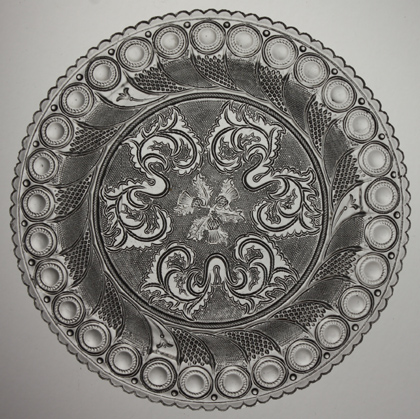
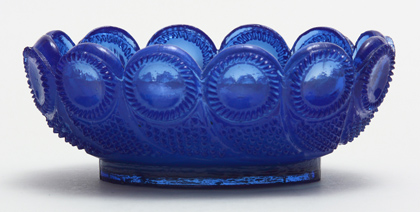
Such is the case for this eight inch diameter pressed plate from the 1830s or early 40s and, in particular, the three commas in its border that contain stylized flowers rather than either tiny or small stippling.
Submitted by zenno on Mon, 12/08/2014 - 23:08
At first glance, some objects makes no sense at all.
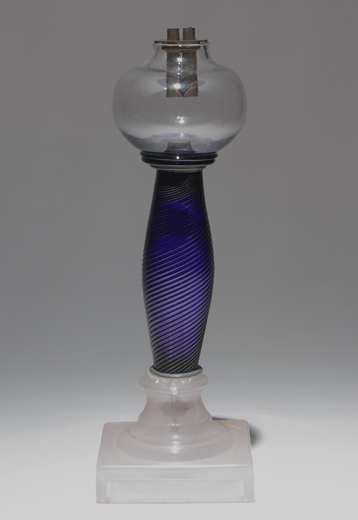
Sure, this is a whale oil lamp. However, its font and stem have nothing at all to do with its foot.
The font and stem are typical—if extraordinarily rare examples—of hand blown lamps of the first quarter of the nineteenth century. However, the base dates to 1850 or even 1870. It is pressed from so-called 'clambroth' colored glass.
Submitted by zenno on Fri, 01/10/2014 - 15:23
I absolutely adored the Venini / Carlo Scarpa exhibit at the Metropolitan Museum (November 5, 2013 - March 2, 2014). It once again demonstrated that the most successful new designs come from a deep love of the past.
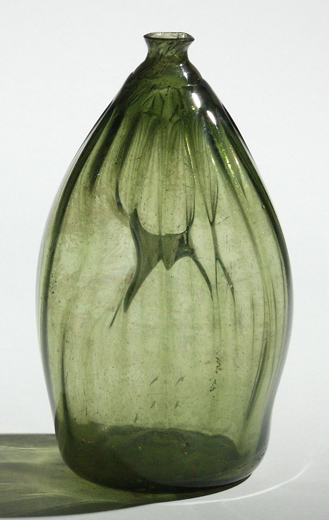
The bottle above belonged to Paolo Venini. It is part of a small collection inherited by his daughter Laura and that found its way to America after she married an American.
Submitted by zenno on Wed, 08/21/2013 - 16:22
Pity the poor prolific author-illustrator, so successful yet full of the belief that her art deserves better than to be turned into mere merchandize!
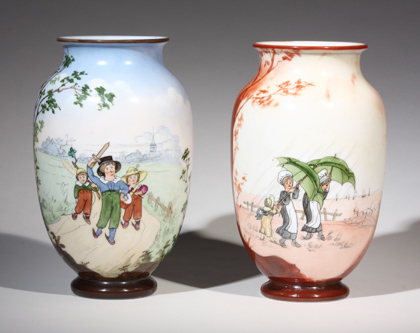
No wonder, then, that these vases are the result of plagiarism rather than authorized products created under the artist's own artistic control, adding to her wealth and encouraging her to produce even more.
Submitted by zenno on Sat, 04/27/2013 - 01:52
Two early pressed salt dishes show that even heavily collected glass keeps on revealing new and unexpected varieties.
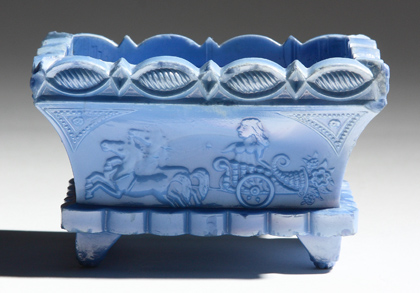
Early pressed glass salt dishes form one of the most attractive groups in early American molded glass.
Submitted by zenno on Fri, 11/30/2012 - 16:46
Part of the curse of esoteric knowledge about the decorative arts is that it can distract you during even the finest historical movies. You bring deep-rooted expectations to the movie — expecting glassware like this — and almost gag at what glass is shown in its place.
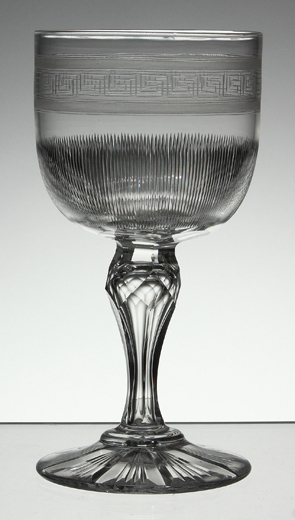
This evening we marveled as Daniel Day Lewis brought Abraham Lincoln to life in Stephen Spielberg's latest masterpiece. They are both geniuses. But why on earth did the production designer choose that glassware, with heavily gilded rims, totally wrong forms and probably made in the 20th Century? And why, if they knew they were guessing, would the director feature it so prominently?
Submitted by zenno on Sat, 10/27/2012 - 02:24
This decanter helps teach the most important lesson required for a collector of early cut glass—that patterns alone are an unreliable guide for either dating or attributing cut glass.
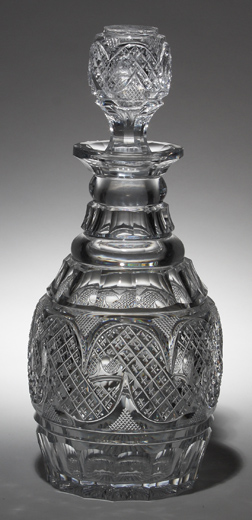
It is cut in one of the most attractive and highly sought after patterns seen on 1830s American cut glass—broad S-shaped scrolls linked together by polished circles. Yet when I bought it, I knew that something strange was going on.
Submitted by zenno on Mon, 01/09/2012 - 21:56
Subtle differences between the centers of two miniature drawer pulls reveal how a mold maker solved a tricky problem — creating a mold with a fixed volume, to be filled with varying quantities of glass.
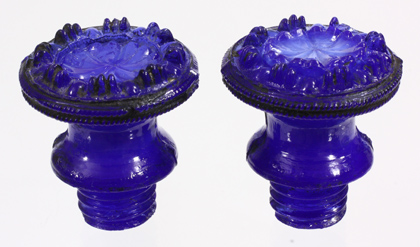
Pressed glass knobs play a special role in glass history.
Submitted by zenno on Wed, 01/04/2012 - 02:35
It took American inventors over thirty years to advance glass pressing to the point where it was capable of this. At 9 inches tall and 7½ inches in diameter, and made by the New England Glass Company circa 1869, it is the largest pitcher pressed before 1880.
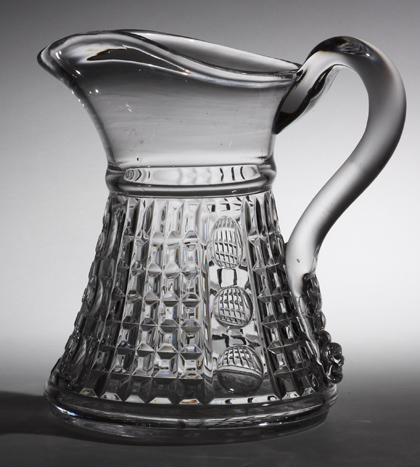
Why did it take so long?
Submitted by zenno on Mon, 09/12/2011 - 19:16
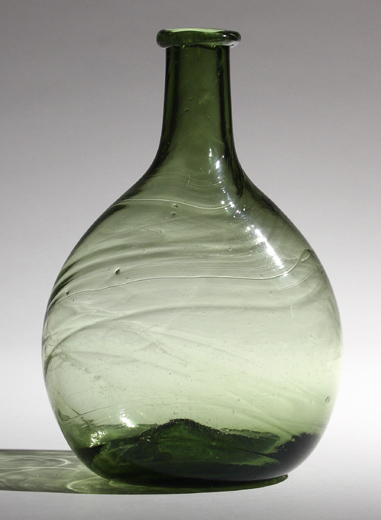
A simple 7 1/2" tall chestnut-shaped blown bottle shows that an object's glass itself can make the object stand out from the crowd.
Pages


